
Patent No.: U.S. Patent 12,415,067 B2
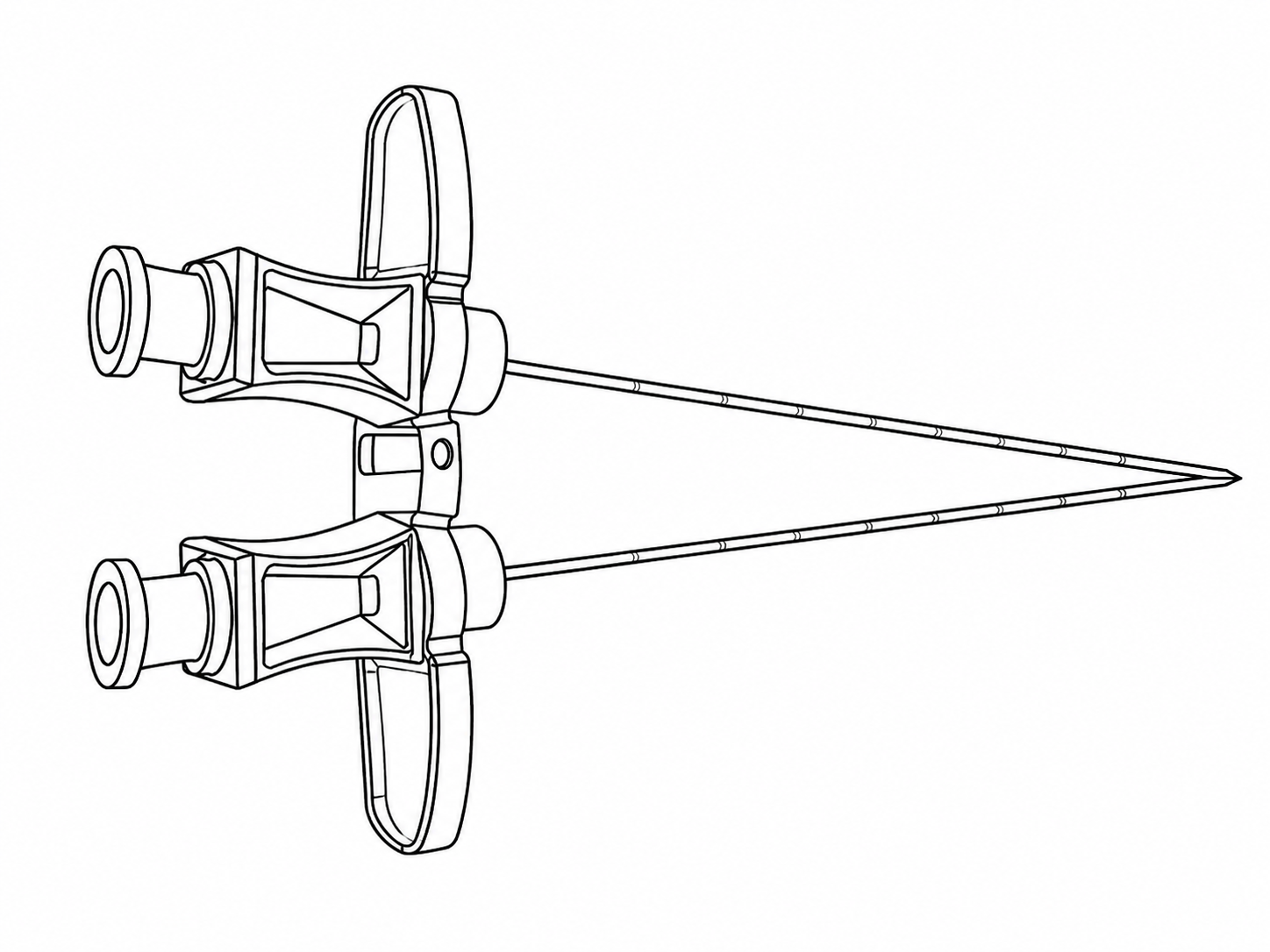
Title: Spinal Cord Stimulator Tuohy Needle Connector and Methods of Use
Inventor: Keith W. Schmidt, MD (sole inventor)
Application No.: 17/944,848
Filed: September 14, 2022
Granted: September 16, 2025
Status: Active (adjusted expiration: January 6, 2044)
USPTO Classification: A61N1/0551 — Spinal or peripheral nerve electrodes
Why this invention matters
Spinal cord stimulation (SCS) is a minimally invasive, reversible treatment for intractable back and leg pain. It works by interrupting pain signals on their way to the brain — and for the right patient, it can dramatically reduce reliance on opioids and restore the ability to work, exercise, and sleep.
But the trial procedure has historically been time-consuming. In the standard bilateral paramedian approach, two Tuohy needles must be placed separately into the epidural space — one at a time, each requiring its own fluoroscopic guidance, its own pass, its own potential tissue disruption. The whole placement step alone routinely takes 30 to 60 minutes, and every additional pass through the epidural space carries small but real risks: dural puncture, bleeding, nerve irritation, and patient discomfort.
Dr. Schmidt designed and patented a better way.
The invention — in plain language
The patented device is a monolithic bridge connector that joins the two Tuohy needles into a single, controllable unit. Both needles enter the same interlaminar opening at the same time, on a coordinated trajectory, instead of being placed one after the other.
The bridge isn’t a rigid welded piece. It uses a tongue-and-groove coupling between two proximal T-wing hubs, so the operator can still angle each needle bilaterally or up and down to find the right anatomy. The angle between the two needles can be tuned anywhere from roughly 10° to 80°, with a single lead-pass opening of 3 to 12 mm between the distal needle tips.
The bridge itself can be made from medical-grade plastic, titanium, or any other biocompatible material — and the connection geometry supports several different coupling mechanisms (latch, pivot, clip, button, magnetic).
Clinical benefits the patent claims
- Shorter procedure time. The two needles are placed in one coordinated motion rather than two sequential motions — cutting roughly 5 to 30 minutes from the placement step.
- Fewer epidural passes. Bilateral leads now share a single lead-pass opening, reducing the number of tracks created in the epidural space.
- Less patient pain during the procedure. Fewer passes through tissue means less mechanical irritation and a more comfortable trial experience.
- More efficient OR / fluoroscopy time. A faster, single-motion placement frees up procedure suite time and reduces cumulative radiation exposure during fluoroscopy guidance.
What it covers — claims
The patent contains 5 claims protecting:
- The device itself: a bridge connector operably coupling two electrode spinal cord needles, with the geometric and mechanical specifications above (angle range, single lead-pass opening, T-wing hub coupling).
- The flexible coupling mechanisms: latch point, pivot point, tongue and groove, clip point, button, magnetic, or equivalent connections.
- The method of stimulation using the connector device.
- The electrode coupling step within the method.
- The lead-feeding step — running the SCS lead through both needles via the same lead pass.
Why this matters for patients
Patents in pain medicine aren’t just engineering trivia. They reflect that the physician performing your procedure has thought deeply about how to make it safer, faster, and less painful — and that he has the engineering judgment and clinical experience to design improvements to the tools the rest of the field uses. Dr. Schmidt’s inventor record is part of the same body of work that has placed him on the American Society of Pain & Neuroscience (ASPN) Healthy Longevity & Age-Related Pain Committee (on which he serves), authored peer-reviewed publications, and earned medical director roles at Ascension Saint Alexius and, previously, UChicago Medicine AdventHealth GlenOaks.
Resources
- USPTO record (Google Patents mirror): patents.google.com/patent/US12415067B2
- USPTO PatentCenter: patentcenter.uspto.gov/applications/17944848
- Related procedures Dr. Schmidt performs: Spinal Cord Stimulator · DRG Stimulation · Peripheral Nerve Stimulation